
Veena Manoj
10 Minutes Read
As a parent in India, you are constantly making choices for your child's future, from selecting the right school to ensuring proper nutrition. Amidst all these decisions, there is one invisible, yet immensely powerful, factor shaping your child's destiny: language exposure.
Between the pivotal ages of three and eight years, your child’s brain is a marvel of nature, showcasing an almost magical capacity for growth known as neuroplasticity. This is not just a time for learning the alphabet; it is a critical window where the richness, complexity, and variety of language they encounter literally builds the neural architecture for all future learning.
Worried about speaking 'correctly' or not doing enough? Please relax. This article is your guide to understanding the profound science of language-rich environments, the far-reaching cognitive benefits it unlocks, and the simple, loving ways you can maximize this brain-building window without adding stress to your busy family routine.
The Science of "Neural Efficiency": What Happens in the Brain
The moment your child hears language—whether it is a paathshaala song, a discussion about the day’s sabzi, or a story from their Dadi—their brain responds with remarkable neural activity. This activity is not just decoding sound; it is constructing the very foundation for lifelong learning.
Every interaction strengthens specific brain pathways dedicated to language processing. Research shows that a child’s brain demonstrates measurable changes in electrical activity very quickly in response to concentrated language.
This reflects the formation of new synaptic connections, leading to what neuroscientists call "neural efficiency."When you read aloud or engage in conversation, multiple regions of the brain activate simultaneously:
- Auditory areas decode the sounds.
- Language centres attach meaning.
- Memory systems store new vocabulary.
- Attention networks maintain focus.
This coordinated, full-brain activity makes the brain faster and more efficient at processing information, which is a key skill needed for academic success.
Why is it important to expose them to languages at a young age?
The brain's ability to reorganize and adapt—its plasticity—is at its peak during early childhood, creating a "critical period" for language acquisition.
Between ages three and eight, your child's brain is uniquely primed to absorb language patterns, grammatical structures, and phonetic distinctions with an ease that fades as they grow older.During this time, rich language exposure does not just add information; it fundamentally shapes how your child’s brain organizes itself.
Children exposed to complex language during these years develop more sophisticated neural networks that support advanced thinking for decades to come.
Why multilingualism is an added advantage to Indian children?
For Indian families navigating multiple languages—English, Hindi, regional dialects, and heritage languages—this news is especially encouraging. Multilingual exposure during the critical period is a cognitive superpower.
Children exposed to multiple languages develop what researchers call "enhanced cognitive control networks." The brain regions responsible for attention, inhibition (impulse control), and task-switching become more robust and efficient. Brain imaging studies show multilingual children have increased grey matter density in areas associated with these executive functions.
Many parents worry that using multiple languages will confuse their child or cause a language delay. Research consistently shows that healthy children can manage multiple languages without confusion when exposure is consistent and meaningful. A temporary mixing of languages (code-switching) is absolutely normal and is a sign of sophisticated language awareness!
How can I add my partner/ spouse to my support system?
Your partner plays a unique role in your support system. Their responsibilities go beyond just attending doctor appointments. Many partners want to help but don't know how, so clear communication about your needs prevents frustration on both sides.
- Encourage your partner to learn about pregnancy changes so they can better understand your experiences.
- Share your daily feelings and concerns openly, and involve them in bonding activities. Examples of bonding activities include talking to the baby or attending prenatal classes together.
- Create specific ways your partner can help: taking over certain household tasks, giving foot massages, preparing healthy snacks, or simply listening when you need to process emotions.
How can I get my family's support during my pregnancy?
In Indian families, pregnancy brings increased attention from extended family members. While this can provide wonderful support, it can also create stress if boundaries aren't established. Remember that saying no to certain family expectations doesn't make you ungrateful — it makes you a responsible mother-to-be.
- Appreciate helpful family involvement while politely but firmly setting limits on unsolicited advice or overwhelming visits.
- Communicate your preferences clearly: "I appreciate your concern about my diet, but I'm following my doctor's recommendations." or "I'd love your company, but I need quiet time in the evenings to rest."
- Understand cultural expectations. Acknowledge the potential for increased family scrutiny and pressure in an Indian context.
- Stay connected through regular check-ins without being overwhelming
- Create a calm, supportive environment during family gatherings
Is it okay to include my friends in my support system?
- Friendships during pregnancy can evolve. Some friends may become more supportive, while others might feel distant if they haven't experienced pregnancy themselves. Nurture relationships with friends who show genuine interest in your journey and can provide emotional support without judgment.
- Consider connecting with other pregnant women through prenatal classes, pregnancy apps, or local meet-ups. These peer connections offer unique understanding because they're experiencing similar changes simultaneously.
Are there any online communities for expecting mothers?
Digital support platforms provide 24/7 access to information and community, especially valuable for working mothers or those with limited local support.
Join reputable pregnancy forums, follow trusted pregnancy apps, and participate in online groups specific to Indian mothers or your local area.Use online communities for emotional support and general information, but rely on healthcare providers for medical guidance.
Can I seek professional pregnancy support services?
Beyond medical care, consider other professional support: counsellors for emotional wellbeing, doulas for birth support, lactation consultants for breastfeeding preparation, or prenatal yoga instructors for physical wellness.
These professionals provide specialized knowledge and support that family and friends, despite their best intentions, may not be able to offer.Beyond doctors and counsellors, digital platforms like
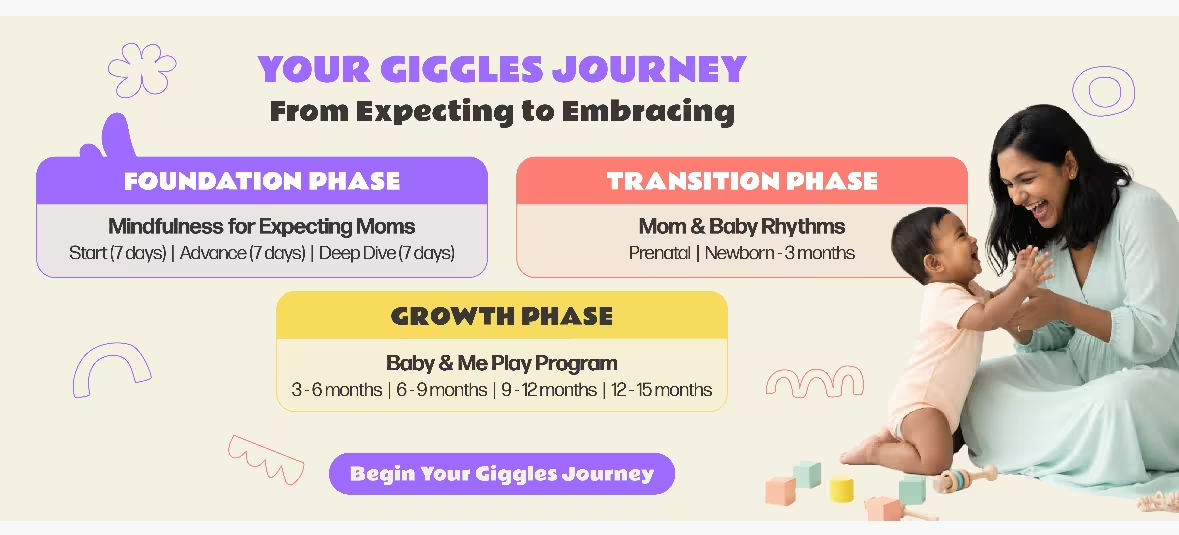
Giggles India are becoming trusted companions for expecting mothers.
Giggles combines expert guidance, mindful parenting practices, and emotional support to help you feel cared for throughout pregnancy and beyond.
Conclusion
A healthy pregnancy needs more than standard medical check-ups — expecting mothers need a comprehensive support system that addresses their physical, emotional, practical, and spiritual needs. A careful approach to building this support system can create the foundation for a more joyful and confident pregnancy experience.
Remember that building a support system is an ongoing process that evolves throughout your pregnancy and into motherhood. Start with your most immediate needs and gradually expand your network as you discover what works best for your situation. No two pregnancies are identical, so customize your support system to match your specific circumstances, values, and preferences.
At its heart, maternal wellbeing comes from feeling supported, understood, and empowered to make the best decisions for yourself and your baby. When you actively build and maintain a strong support network, you're not just caring for your pregnancy — you're modelling self-advocacy and community-building skills that will serve both you and your child throughout your lives together.
Take the first step today by identifying one area where you need more support and reaching out to appropriate resources. Your future self and your baby will benefit from every effort you make to strengthen your support system during this transformative time.
At
Giggles India, we understand that motherhood is easier when you are supported. Our app offers expert-backed resources, mindful parenting tools, and a warm community that walks with you every step of the way. Download the Giggles app today and begin building your circle of support.
Veena Manoj
Giggles is a screen free, research based program that helps you bond with your baby through simple music, movement, stories, and calm play.
.svg)
.svg)
.svg)
.svg)

.svg)
.png)
.svg)
.svg)
.svg)
.svg)
.svg)
.svg)
.svg)
.svg)
.svg)
.svg)
.svg)
.svg)
.svg)